

 Written by
 Today’s rapidly evolving world, education must go beyond imparting knowledge to equipping individuals with the ability to navigate real-world complexities. While traditional education focuses on academic subjects like math, science, and literature, it often overlooks a critical skill: thinking and decision-making. Specifically, Value-Based Thinking, defined as “the act of developing the thought process of self-awareness to create a positive result from each action to add value to either self or others in any possible way or sense,” is an essential aspect of learning that completes education. This article explores why Value-Based Thinking is indispensable for everyone, how it bridges gaps in traditional education, and how it empowers individuals to thrive in the real world. By integrating insights from upskillshare.com and related resources, we highlight its role in fostering personal growth and societal impact.The Gap in Traditional EducationTraditional education systems excel at teaching facts, formulas, and frameworks but often neglect the development of thinking skills, particularly those that guide decision-making. Subjects like history or biology provide foundational knowledge, but they rarely teach students how to think about the choices they face in life—whether it’s choosing a career, solving a workplace problem, or contributing to society. This gap leaves individuals unprepared for real-world challenges, where decisions are rarely black-and-white and require aligning actions with personal and societal values.Value-Based Thinking addresses this gap by fostering a mindset that prioritizes self-awareness and value creation. It encourages individuals to ask:What is valued in this context (e.g., personal fulfillment, community well-being)?
Is this value subjective (personal) or objective (universal)?
How can I integrate this value into my actions, products, or decisions?
By embedding this thought process, education becomes a tool not just for acquiring knowledge but for applying it meaningfully in real-world scenarios.Related Resource on upskillshare.com: The article “The Importance of Self-Awareness in Decision-Making and Value Based Thinking” (https://upskillshare.com/the-importance-of-self-awareness-in-decision-making-and-value-based-thinking/) emphasizes how self-awareness, a core component of Value-Based Thinking, enhances decision-making, aligning with the need for practical skills in education.Why Value-Based Thinking is Essential for EveryoneValue-Based Thinking is not just a skill—it’s a transformative approach that completes education by preparing individuals for the complexities of life. Here’s why it’s essential for everyone:Enhances Decision-Making in a Complex World
The real world is filled with ambiguity, competing priorities, and ethical dilemmas. Whether deciding on a career path, managing finances, or addressing social issues, individuals need a framework to make informed choices. Value-Based Thinking provides this by encouraging people to start with their values—such as integrity, sustainability, or empathy—before exploring options. This mirrors Value-Focused Thinking, a decision-making framework by Ralph L. Keeney, which prioritizes values over alternatives (https://sloanreview.mit.edu/article/creativity-in-decision-making-with-valuefocused-thinking/). For example, a student choosing between a high-paying job and one aligned with their passion for environmental conservation can use Value-Based Thinking to prioritize long-term fulfillment over short-term gains.
Fosters Self-Awareness and Purpose
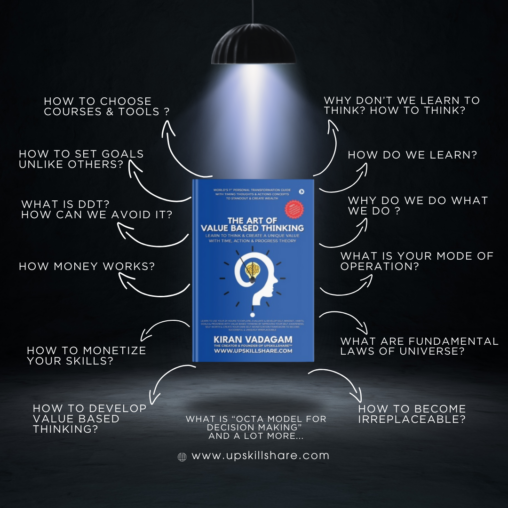
Education often focuses on external achievements (e.g., grades, degrees), but Value-Based Thinking shifts the focus inward, cultivating self-awareness. By understanding what they value—whether it’s family, innovation, or social justice—individuals can make decisions that align with their purpose. This is critical in a world where mental health challenges and burnout are prevalent, as seen in trends reported on platforms like X in 2025, where discussions highlight the need for purpose-driven careers. Self-awareness ensures that education translates into a meaningful life, not just a checklist of accomplishments.Related Resource on upskillshare.com: The book The Art of Value-Based Thinking by Kiran Vadagam (https://upskillshare.com/product/the-art-of-value-based-thinking/) provides practical tools to develop self-awareness, guiding readers to align actions with their core values.
Prepares for Real-World Problem-Solving
Real-world problems, such as climate change, social inequality, or workplace conflicts, require solutions that create value for multiple stakeholders. Value-Based Thinking equips individuals to frame “sensible and pursuable questions” that address these challenges. For instance, a professional might ask, “How can I design a product that is both affordable and sustainable?” By focusing on value creation, this approach ensures solutions are not just functional but also ethical and impactful. This is particularly relevant in 2025, where global discussions (e.g., on X and web sources) emphasize sustainable innovation and inclusive growth.
Builds 21st-Century Skills
The World Economic Forum and other sources highlight critical thinking, problem-solving, and emotional intelligence as top skills for the 21st century (https://www.weforum.org/agenda/2020/10/top-10-work-skills-of-tomorrow-how-long-it-takes-to-learn-them/). Value-Based Thinking integrates these by encouraging individuals to think critically about values, solve problems creatively, and empathize with others’ needs. Upskillshare.com’s courses on soft skills and cognitive development (https://upskillshare.com/courses/) directly support this, offering training to build these competencies.
Promotes Societal Impact
Education should not only benefit the individual but also society. Value-Based Thinking encourages actions that create positive outcomes, such as supporting community initiatives or designing systems that promote equity. For example, an entrepreneur might use Value-Based Thinking to develop a business model that prioritizes fair wages, reflecting societal values of fairness. This aligns with upskillshare.com’s mission to foster skills that contribute to wealth and value creation, as discussed in their article “What we don’t learn early is Value & Wealth Creation – Value Based Thinking to Create Wealth (Part 1)” (https://upskillshare.com/what-we-dont-learn-early-is-value-wealth-creation-value-based-thinking-to-create-wealth-part-1/).
How Value-Based Thinking Completes EducationEducation is incomplete without teaching individuals how to think and make decisions that align with their values and societal needs. Value-Based Thinking bridges this gap by:Connecting Knowledge to Action
Academic knowledge is valuable, but without a framework to apply it, it remains theoretical. Value-Based Thinking teaches individuals to use knowledge to create tangible outcomes, such as designing solutions that address real-world needs. For example, a student learning about renewable energy can apply Value-Based Thinking to design community projects that promote sustainability, making education actionable.
Navigating Ethical Dilemmas
The real world is full of ethical challenges, from workplace decisions to global issues. Value-Based Thinking provides a moral compass, helping individuals evaluate whether their actions align with subjective (personal) or objective (universal) values. This is critical in fields like business or technology, where ethical considerations are increasingly scrutinized, as seen in 2025 discussions on AI ethics and corporate responsibility.
Empowering Lifelong Learning
Education doesn’t end with a degree—it’s a lifelong process. Value-Based Thinking fosters a growth mindset, encouraging individuals to continuously reflect on their values and adapt to new challenges. Upskillshare.com supports this through resources like “What Students Should Learn From Leonardo Da Vinci’s Approach To Value Based Thinking & Learning” (https://upskillshare.com/2024/12/06/what-students-should-learn-from-leonardo-da-vincis-approach-to-value-based-thinking-learning/), which highlights how historical figures used value-driven thinking to innovate.
Enhancing Emotional and Social Intelligence
By focusing on creating value for others, Value-Based Thinking builds empathy and collaboration skills. For instance, a manager using this approach might prioritize employee well-being, leading to a more cohesive team. This emotional intelligence is a key component of modern education, preparing individuals for leadership and teamwork in diverse settings.
Practical Steps to Integrate Value-Based Thinking into EducationTo make Value-Based Thinking a core part of education, stakeholders can take these steps:Incorporate It into Curricula
Schools and universities should introduce courses or modules on critical thinking and decision-making, using Value-Based Thinking as a framework. For example, case studies on ethical dilemmas can teach students to prioritize values in their decisions.
Leverage Online Platforms
Platforms like upskillshare.com offer accessible resources to learn Value-Based Thinking. Their courses on soft skills and articles on decision-making (https://upskillshare.com/) provide practical tools for students, professionals, and lifelong learners.
Encourage Reflective Practices
Educators can promote journaling or group discussions to help students reflect on their values and how they influence decisions. This builds self-awareness, a cornerstone of Value-Based Thinking.
Foster Real-World Applications
Project-based learning, where students tackle real-world problems (e.g., designing sustainable products), can embed Value-Based Thinking into education. This approach aligns with upskillshare.com’s focus on practical skill development.
ConclusionValue-Based Thinking is not just a skill—it’s a mindset that completes education by equipping individuals to navigate the real world with purpose, clarity, and impact. By addressing the gap in traditional education, which often overlooks thinking and decision-making, it empowers people to make choices that align with their values and create positive outcomes for themselves and society. As of July 25, 2025, the need for such skills is evident in global trends emphasizing sustainability, ethics, and purpose-driven lives. Resources like upskillshare.com, with its book The Art of Value-Based Thinking, articles, and courses, provide a robust platform to learn and apply this approach. By embracing Value-Based Thinking, we can transform education into a tool for personal growth and societal progress, ensuring everyone is prepared to thrive in an ever-changing world.Call to Action: Explore Value-Based Thinking further on upskillshare.com (https://upskillshare.com/) and start integrating it into your learning journey today!Summary Table of Key PointsAspect
Description
Why It’s Essential
Enhances decision-making, fosters self-awareness, prepares for real-world challenges.
Completes Education
Connects knowledge to action, navigates ethical dilemmas, promotes lifelong learning.
Practical Steps
Integrate into curricula, leverage online platforms, encourage reflection.
Resources on upskillshare.com
Book, articles, and courses on Value-Based Thinking and soft skills.
Related Articles on upskillshare.com:The Importance of Self-Awareness in Decision-Making and Value Based Thinking
What we don’t learn early is Value & Wealth Creation – Value Based Thinking to Create Wealth (Part 1)
What Students Should Learn From Leonardo Da Vinci’s Approach To Value Based Thinking & Learning
By embedding Value-Based Thinking into education, we can ensure that learning is not just about acquiring knowledge but about creating value that transforms lives and communities.
Value-Based Thinking, decision-making, self-awareness, critical thinking, education reform, 21st-century skills, real-world navigation, personal growth, societal impact, upskillshare.comHashtags: #ValueBasedThinking #EducationReform #CriticalThinking #DecisionMaking #21stCenturySkills #SelfAwareness #PersonalGrowth #UpskillshareIntroductionIn