
 Written by
 Contributed by: Parthavi Nistala
Artificial intelligence is transforming the education sector by reshaping the methods in which students learn, understand, and interact with information. AI-powered educational tools and platforms such as Grammarly, Khanmigo, and ChatGPT, are increasingly becoming part of the classroom activities and study habits. These innovations promise personalized learning experiences, instant feedback, and better access to educational resources. For many students, AI serves as a virtual tutor, helping the understand difficult concepts and improving their writing and problem-solving skills.
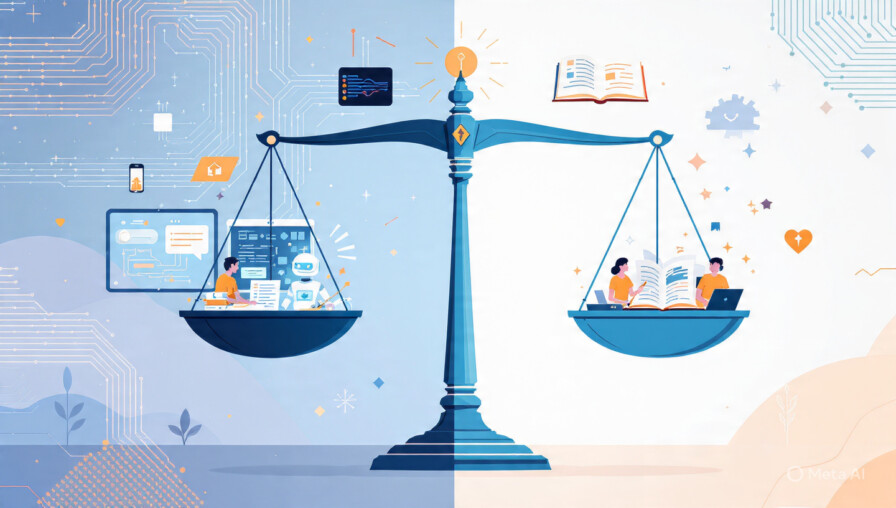
However, the increasing use of AI in education also brings up serious problems. While this technology can increase the effectiveness of learning, there is a risk that they could encourage over-reliance, weaken critical thinking, and blur the boundaries of academic integrity. As AI becomes more deeply embedded in education, we need to consider both its potential to help and the drawbacks it presents. Finding the right balance is crucial to figuring out whether AI will ultimately enrich education or diminish the skills it aims to support.
Overdependence
Students may gradually lessen their own effort in comprehending the material if they rely too much on AI systems to generate ideas, explain concepts, or even complete their assignments. Students and learners may start relying on automated solutions rather than improving their critical thinking and problem-solving abilities. This dependency could eventually affect critical thinking and creativity – two crucial skills in academics and beyond.
Academic Integrity
AI systems can draft essays, solve puzzles, and summarise data remarkably fast. When used responsibly, this can enhance learning, but it also gives students the chance to turn in AI-generated work as their own. Because these tools are so easy-friendly and many of them can be used for free, it can be challenging for educators to identify such misuse, and conventional ways of evaluation are made more difficult. Hence, schools are now faced with more challenges in maintaining academic integrity and fairness in the educational environment.
Accuracy and Reliability
AI systems also raise concerns about accuracy and reliability. While the AI models provide useful information, they are not always accurate. They can give convincing responses that contain factual errors or misleading explanations. Students who use AI and do not take time to verify the information generated may unintentionally learn incorrect concepts. This makes critical evaluation skills even more important when engaging with AI-generated content.
Lack of Human Interaction
Education extends beyond mere information gathering – it encompasses dialogue, mentoring, and collaborative learning. Teachers play a crucial role in guiding students, igniting curiosity, and enabling meaningful connections among various ideas. While AI can simulate discussions and offer explanations, it cannot fully replace the “human-in-the-loop” for the emotional support, encouragement, and experiential wisdom that human educators bring to the classroom.
When Used Responsibly, AI Works for Everyone
The concerns raised above are real. But they are not arguments against AI — they are arguments against unguided AI. When institutions, educators, and students approach these tools with clear boundaries and deliberate intent, the picture changes significantly.
For Students
Consider what responsible integration actually looks like in practice. Students who use AI as a thinking aid — to clarify a concept they didn’t grasp in class, to get feedback on a draft before revising it themselves, or to explore different perspectives on a topic — are not bypassing learning. They are extending it. A 2025 peer-reviewed study found that students in AI-supported learning environments outperformed their peers in traditional instruction by up to 15.4% in assessment scores, while also reporting higher confidence and satisfaction levels. ACM Digital Library The difference between those outcomes and the risks outlined earlier comes down to one thing: structure
For Educators
Responsible AI use is less about policing and more about repositioning. In 2026, educators increasingly expect AI to work within their existing Learning Management Systems rather than as a separate platform — and when it does, it stops feeling experimental and starts becoming a natural part of everyday teaching. Teachers who use AI to handle routine administrative tasks, generate first-draft feedback, or flag students who may need additional support are not being replaced by the technology. They are using it to do more of what only a human teacher can do.
For Learning Management Systems
LMS themselves are evolving accordingly. AI integration within LMS platforms can increase learner engagement through personalized and interactive content delivery. When AI is embedded into the systems students already use — rather than existing as a separate, unmonitored tool — institutions retain far greater visibility and control over how it’s being used.
Crucially, policy is finally starting to catch up. Between 2024 and 2025, the share of university students who believed their institution’s staff were well-equipped to work with AI tools more than doubled — rising from 18% to 42%. That’s a meaningful shift. Institutions like the University of Texas at Austin have moved beyond vague guidance – launching formal responsible AI frameworks specifically designed to help students, faculty, and staff to use these tools ethically and effectively in teaching and learning contexts.
None of this means the risks disappear. They don’t. But they become manageable — and even productive — when AI is treated not as a shortcut, but as a scaffold. A scaffold that holds you up while you build the skills, and is designed to come down once you’ve built them.
The goal was never to hand students a machine that thinks for them. The goal is to use that machine to help them think better.
Conclusion
Clearly, AI is not the enemy of education. Neither is it the solution to everything. It is a tool — powerful, imperfect, and entirely dependent on the intentions and guardrails surrounding its use. The schools and universities that will get this right aren’t the ones that ban it outright, nor the ones that adopt it without question. They’re the ones willing to have the harder conversation: about what learning is actually for, what skills genuinely matter, and where human judgment must remain non-negotiable.
Students, educators, and institutions don’t need to choose between embracing AI and protecting the integrity of education. But they do need to choose how — deliberately, critically, and with enough honesty to admit that the answers are still being worked out. That kind of thoughtful uncertainty isn’t a weakness. It’s exactly the disposition that good education is supposed to produce.
AI didn’t create the challenges facing modern education. But how we respond to it will say everything about what we believe education is truly for.